
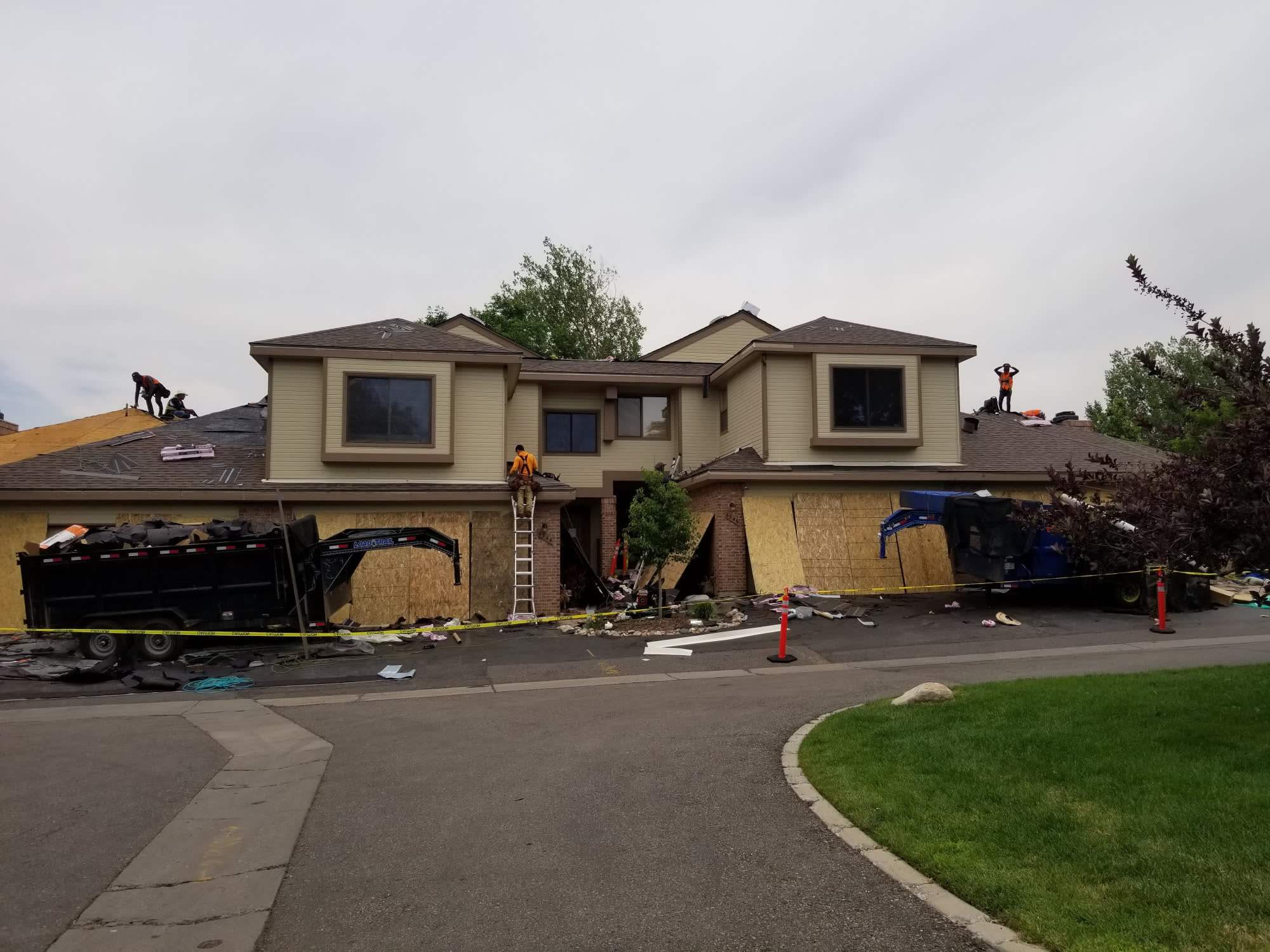
The first twenty-four hours after a hail storm are the most important. What you do (and do not do) in that window largely determines how smoothly your insurance claim goes and how well your roof gets replaced. Use this checklist as a reference the next time a storm rolls through the Front Range or eastern Kansas.
Step 1: Make Sure Everyone Is Safe
Before you worry about the roof, confirm that no one in the household is injured, that pets are accounted for, and that there is no active leak dripping onto electrical fixtures. If the storm brought down a tree limb or pulled power lines loose, stay inside and call your utility. Do not climb onto your roof during or immediately after a storm. Water, hail melt, and damaged shingles make the surface slick, and even a small fall is dangerous.
Step 2: Document Damage From the Ground
Once it is safe to go outside, start taking photos. You are building a record you will hand to your insurance adjuster and to your contractor. Shoot:
- Hail stones on the ground. Place a quarter, golf ball, or ruler next to them for scale. Time-stamp the photos.
- Dented gutters, downspouts, and metal vents. Hail leaves dents on soft metals before it cracks shingles. This is a key indicator.
- Damaged siding, window screens, and fences. Collateral damage often travels with the claim.
- Damaged vehicles, patio furniture, AC condenser fins. Separate claims may apply.
- Shredded leaves in the yard. Adjusters use leaf shred as a storm intensity indicator.
Save the photos in a dated folder on your phone or computer. Do not delete them, even if the claim drags on for months.
Step 3: Do Not Sign Anything From a Door-Knocker
Within hours of a hail event, out-of-state storm chasers will start knocking. Some are reputable contractors following the work. Many are not. The ones to avoid will push a "contingency agreement" or "work authorization" at you on the spot, often pitched as "just to get the inspection started" or "so we can work with your insurance on your behalf."
Read anything before signing. If a form:
- Commits you to using that contractor if the claim is approved,
- Grants them power of attorney to negotiate with your carrier,
- Includes a cancellation penalty, or
- Lacks a local address and Colorado or Kansas license number,
put it down. You are under no obligation to pick a contractor before you have filed the claim. A legitimate company, ours included, is happy to inspect and quote with no commitment.
Step 4: Call Your Insurance Company
Every carrier has a claims phone number on the back of your policy and on your ID card. Call them directly or use the carrier's app. You are reporting a hail event, the approximate date and time, and the damage you have observed so far. They will open a claim number and schedule an adjuster to visit.
A few tips:
- File promptly. Most Colorado, Kansas, Missouri, Nebraska, and Wyoming policies require claims to be reported within a year of the storm, and some have shorter windows. Sooner is always better.
- Be factual. Report what you see. Do not speculate about cause or dollar amounts.
- Ask for your claim number and the adjuster's contact info. Write these down.
Step 5: Get an Independent Roof Inspection
Ideally, you have a contractor inspect the roof before the adjuster's visit and, even better, meet the adjuster on site. A contractor who knows what storm damage looks like can point out impacts the adjuster might miss, especially on hidden slopes.
A thorough inspection includes:
- Every roof slope, not just the front. Hail driven by wind often hits one side harder.
- Soft metals like vents, flashing, and gutter aprons. Dents here are strong evidence.
- Ridge caps and hips, where shingles are often the first to fail.
- Attic inspection for daylight, staining, or wet insulation.
- Siding, windows, screens, garage door, and HVAC unit for collateral damage.
We document every finding with photos, a drone overhead, and a written scope that can be submitted to your carrier. If you are considering Roof Technologies for the work, that same documentation becomes the basis for the residential roofing estimate.
Step 6: Meet the Adjuster On Site
When the adjuster arrives, it helps to have your contractor present. The two discuss findings, walk the roof together, and agree on a scope of loss. Carriers call this a "joint inspection" and most accept it as best practice. You do not need to be on the roof yourself; stay on the ground and take notes.
After the inspection, the adjuster writes an estimate. You will receive a copy, typically within a week or two. Review it carefully. If line items are missing, your contractor can file a supplement with additional documentation.
Step 7: Choose Your Contractor and Schedule the Work
Once the claim is approved, you pick the contractor. You are not required to use anyone your insurance recommends. Pick based on:
- Local presence. A Colorado or Kansas address and license.
- Workmanship warranty in writing.
- Proper insurance coverage, including workers comp.
- References and a track record of handling claims.
Step 8: Keep Every Document
Hang onto your photos, your claim paperwork, the adjuster's estimate, your contractor's scope, and every invoice. If the carrier holds back depreciation as recoverable (RCV), you will need proof of completed work to get the final check released.
Quick Recap
Safety first. Document everything. Do not sign hastily. Call your carrier. Get an independent inspection. Meet the adjuster with your contractor. Choose a local company. Keep records. Follow that sequence and the claim process will go as smoothly as claim processes ever go.
Just Had a Storm? Get a Free Inspection
We inspect your roof, document any damage, and meet your adjuster on site at no cost and no obligation.
Get a Free Estimate or call 855 ROOF-001