- Call Us Today! 855 ROOF-001
- Email: info [at] RoofTechnologies.com

Tile Roofing — Built to Outlive the House
Concrete, clay, and composite tile roofing across Colorado, Kansas, Missouri, Nebraska, and Wyoming. Bartile, Eagle Roofing, Boral/Inspire, MonierLifetile, US Tile, Ludowici American clay, plus DaVinci, Brava, and F-Wave synthetic alternatives. New tile installs, hail-event repairs, full re-underlayment with tile reuse, and Westile Lightweight replacement — the work behind a roof that lasts longer than you will.
The Tile Itself Is Effectively Permanent — What You Maintain Is the Underlayment Beneath It
A properly installed tile roof is the longest-lived residential roofing system on the market. Concrete tile carries a 50-100 year service life; clay tile routinely outlasts the building it sits on. Properly installed clay roofs in Italy and Spain are still in service after a century-plus on their original tile. The tile is not what wears out.
What wears out is the underlayment — the felt or synthetic membrane between the tile and the deck — and that mismatch is the central fact of owning a tile roof. Traditional 30 lb felt underlayment lasts 25-30 years. Modern high-temp synthetic underlayment lasts 30-40 years. Tile lasts much longer than either of them. Most of what we do as a tile contractor is not new tile installation: it is removing existing tile, replacing the underlayment beneath, and re-setting the original tile for another 30+ years of service.
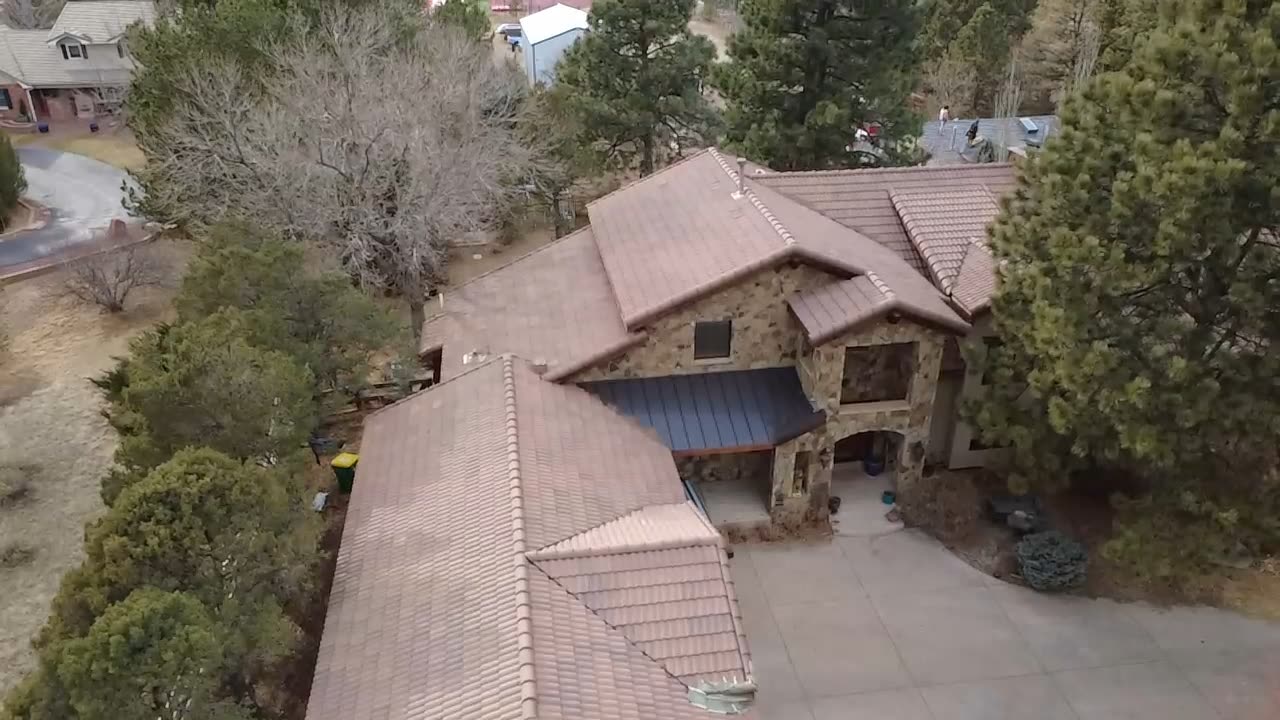
We install new concrete and clay tile roofs, repair storm and hail damage, replace failed Westile Lightweight roofs, and execute full underlayment-only re-roof scopes that preserve and reset existing tile. Across Colorado, Kansas, Missouri, Nebraska, and Wyoming — on the kind of multi-gable, custom-architecture homes where tile was originally specified for the look, the longevity, and the fire performance.
Concrete, Clay, and Composite — Three Real Categories, Different Math
"Tile" covers three distinct material families. Each has its place. The right one for your roof depends on the structure, the budget, the architecture, and the look you want twenty years out.
Portland Cement, Pressed and Cured
Concrete tile is portland cement, sand, and pigment compressed under high pressure into a tile shape and cured. It dominates modern American tile construction — broader color range, lower cost than clay, and available in profiles from flat shake-look to deep S-tile. Color is either color-through (pigment mixed throughout the body) or slurry-finished (pigment sprayed on the surface and cured in). Color-through is the premium spec; slurry can fade over decades but starts richer.
- Weight: 900-1,100 lbs/sq traditional; 580-700 lbs/sq lightweight
- Lifespan: 50-100 years
- Fire: Class A intrinsic
- Hail: UL 2218 Class 4 on premium profiles
- Wind: 110-150 mph properly installed
Fired Ceramic, Color Baked Through
Clay tile is fired ceramic — the original tile material, in continuous use across Mediterranean, Spanish, and Italianate architecture for over two thousand years. Color is baked through the body during kilning, which is why old clay tile roofs read as warmer and more uniform than concrete: the pigment is the material, not a coating. Clay is more brittle than concrete to walk on, harder to source replacement tile for once a color run is discontinued, and runs 30-60% more expensive than equivalent concrete.
- Weight: 900-1,000 lbs/sq full-bodied profiles
- Lifespan: 75-100+ years
- Fire: Class A intrinsic
- Hail: Class 4 available on selected profiles
- Color: Permanent, fired-through
Polymer Engineered to Read Like Slate or Shake
Composite tile is a different category entirely — molded polymer (typically a high-grade thermoplastic blend) engineered to mimic slate, shake, or Spanish tile with much deeper relief than asphalt and a 50-year-class lifespan. DaVinci Roofscapes, Brava, F-Wave, and Inspire Synthetic Slate are the leading lines. Composite weighs 200-450 lbs per square — roughly a third to a quarter of traditional concrete tile — which makes it the right answer when the structure won't carry full-weight tile or when reduced load is itself the goal.
- Weight: 200-450 lbs/sq
- Lifespan: 50-year-class manufacturer warranty
- Fire: Class A available on most lines
- Hail: UL 2218 Class 4 standard on most lines
- See: composite.php
Tile Product Lines We Install & Warranty
Premium concrete, American and European clay, and composite alternatives. The lineup we keep on our spec sheet — plus the discontinued lines we replace.
Bartile (Premium, Utah-Based)
Premium American concrete tile. The Legendary Shake line is what we put on the Cherry Hills Village estate.
- ProfileFlat shake, S-tile, slate-look, Legendary Shake
- Weight~900-1,000 lbs/sq
- ColorColor-through, multi-blend
- FireClass A intrinsic
- HailUL 2218 Class 4
Eagle Roofing Products
Largest concrete tile manufacturer in the western U.S. Broad profile and color range.
- ProfileFlat, low-profile, S-tile, barrel
- Weight~900-1,100 lbs/sq
- ColorColor-through and slurry options
- FireClass A
- HailClass 4 on premium lines
Westlake Royal (formerly Boral)
The brand formerly known as Boral Roofing. Strong national presence with a deep commercial and residential profile range.
- ProfileSaxony, Estate, Madera, S-tile
- Weight~900-1,000 lbs/sq
- ColorThrough-body and surface-blend
- FireClass A
- HailClass 4 available
US Tile (now Westlake Royal)
U.S. Tile's concrete profiles — the line is now under the Westlake Royal brand. Frequently encountered on legacy California-Colorado custom homes; current production is fully supported.
- ProfileS-tile, mission, barrel
- Weight~900-1,100 lbs/sq
- FireClass A
- UseCurrent production + match-source for older installs
Monier (Discontinued)
Legacy concrete tile manufacturer; the Monier line is no longer in production. We replace and color-match Monier installs across the western U.S.
- StatusDiscontinued; legacy install base
- ProfileS-tile, flat, barrel, mission
- Replace WithWestlake Royal, Eagle Roofing, Bartile
- Match SourceSalvage and selective matching available
Lifetile (Discontinued)
Legacy concrete tile manufacturer (originally a separate brand from Monier; the two were merged into MonierLifetile before production ended). We replace and match Lifetile installs.
- StatusDiscontinued; legacy install base
- ProfileS-tile, flat, barrel
- Replace WithWestlake Royal, Eagle Roofing, Bartile
- Match SourceSalvage and selective matching available
Westile Lightweight (Discontinued / Failing)
Documented systemic failure pattern. Manufacturer closed ahead of litigation. We replace these roofs.
- StatusDiscontinued; manufacturer closed
- FailureSpalling, cracking, edge breakdown
- Replace WithBartile, Eagle, Boral/Inspire, or composite
- Track RecordWe've replaced multiple in CO
Ludowici (Premium American Clay)
Ohio-based premium American clay manufacturer — the historical reference for U.S. clay tile.
- ProfileSpanish, French, Greek, slate-look
- Weight~900-1,000 lbs/sq
- ColorFired-through, permanent
- Lifespan75-100+ years
- UseCustom estate, historic preservation
MCA Clay Roof Tile
California-based clay manufacturer. Strong color and profile range for Mediterranean and Spanish-mission work.
- ProfileS-tile, mission, two-piece barrel
- Weight~900-1,000 lbs/sq
- ColorFired-through
- Lifespan75-100+ years
Synthetic Alternatives
When the structure won't carry concrete or clay — or when lighter weight and Class 4 hail are the priority.
- Weight200-450 lbs/sq
- ProfileSlate, shake, Spanish tile look
- HailUL 2218 Class 4 standard
- Detailcomposite.php & specialty-roofing.php
Profile Drives How the Roof Reads from the Street
Tile is not one shape. The profile — flat, low-relief, deep barrel, or hand-split shake — is the most important visual choice on a tile roof, and it is mostly an architectural decision rather than a performance one.
Low-relief tile that reads like dimensional shingle from a distance. Modern, transitional, and contemporary architecture. The most common new-construction tile profile in our footprint.
The single S-curve interlocking profile. The classic Spanish-tile look at a single-piece tile cost. Workhorse profile for Mediterranean and Southwestern architecture.
Half-round profile. Deeper shadow lines than S-tile, more pronounced texture from the curb. Often seen on luxury Spanish and Italianate custom homes.
Authentic Spanish-mission — separate cap and pan tiles. The deepest, most traditional Spanish tile look. Higher labor cost than single-piece S-tile because every tile is two pieces.
Flat tile with rectangular slate dimensions and color blends. The look of natural slate at a fraction of the cost. Common on Tudor, French Country, and English-influenced architecture.
The Underlayment Is the Maintenance Item
Tile lasts 50-100+ years. Underlayment lasts 25-40. Once you own that arithmetic, the rest of tile-roof maintenance falls into place.
Almost every "tile roof failure" we are called to inspect is actually underlayment failure. The tile is doing its job — shedding water as the primary weather barrier. The underlayment beneath is the secondary barrier, and when it ages out, water that gets past minor tile cracks or wind-driven rain at flashings finds its way to the deck. The first symptom is usually scattered interior leak calls that don't have a clear single source. The second is staining at eave soffits even when gutters are working. Both point at underlayment, not tile.
The work is exactly what it sounds like: pull the tile carefully, set it aside in stacks, install modern ice-and-water shield at eaves and valleys plus high-temp synthetic over the field, replace flashings, replace any cracked tile from matched sourcing, and re-set the original tile. The system gets another 30+ years of service life and the visual character of the original tile is preserved.
Tile vs. Underlayment Lifespan — The Math
Bartile, Eagle, Boral/Inspire
Ludowici, MCA
Standard older spec
Modern spec
Reuses existing tile
All-new tile + underlayment
The Westile Lightweight Problem — Why We Replace These Roofs
Westile Lightweight was a concrete tile product manufactured during the late-model era of American concrete tile production. It carried a meaningful market share across Colorado custom-home construction in the 1990s and early 2000s. It also carried a documented systemic failure pattern.
What homeowners and inspectors started seeing was a consistent set of symptoms across Westile Lightweight roofs as they aged: spalling (the surface of the tile flaking off in layers), edge cracking at the leading and trailing tile edges, and progressive structural breakdown of the tile body that ran ahead of the manufacturer's published warranty curve. These failures were not isolated — they were the rule on Westile Lightweight roofs as they aged into the 15-25 year window. The Westile company eventually closed its doors as litigation moved through Colorado courts; the timing of the shutdown lined up exactly with the wave of legitimate product-defect claims that were being filed.
For a homeowner, the practical implication is direct: if your roof is Westile Lightweight and it is showing widespread spalling or crack patterns, this is not a candidate for spot repair. The tile is going to keep failing. The right scope is replacement — either with a premium concrete from a manufacturer with a clean track record, or with a lighter-weight composite alternative that comes with reduced structural load as a bonus.
If you have a Westile Lightweight roof and want a documented condition assessment, we'll walk it, photograph the failure patterns by slope, and put together a written scope. We've replaced multiple Westile roofs across Colorado, and we know the failure pattern when we see it.
250+ Squares of Bartile Legendary Shake — Rough-Cut Staggered, Cherry Hills Village
Our flagship tile project of recent years: a custom luxury estate in Cherry Hills Village, metro Denver. The original roof was failed Westile Lightweight — widespread spalling and crack patterns that had pushed the homeowner past the point of spot repair. The replacement scope was 250-plus squares (more than 25,000 square feet of roof surface) of Bartile Legendary Shake concrete tile in a rough-cut staggered install pattern — varied tile widths and irregular courses that, done right, makes a concrete roof read like hand-split cedar shake from the street.
That install pattern is the technical detail that distinguishes a good tile roof from an exceptional one. Straight-course tile installation lays every tile in uniform rows with consistent exposure — clean, fast, and visually obvious as a tile roof. Rough-cut staggered installation deliberately breaks the repetition: tiles are cut to varied widths, courses are offset, and the eye reads texture instead of pattern. It is meaningfully slower work — each tile gets selected and cut individually — and on 250 squares it added real hours to the project. The result is what makes the difference between a $1.5M tile roof and a $1.5M roof that looks the part.
Read the full project breakdown: Luxury Tile Estate — Cherry Hills Village →
Performance Specs — What Tile Actually Delivers
The numbers behind the longest-lived residential roofing system on the market.
Highest fire rating available. Intrinsic to concrete and clay — not coating-dependent. Critical in WUI zones across Colorado and Wyoming.
Premium concrete profiles meet the highest impact rating available. Tested against a two-inch steel ball dropped from 20 feet.
When properly installed with the manufacturer's high-wind attachment schedule (every tile mechanically fastened, not just nose-hooked).
Premium concrete and clay tile is engineered for repeated freeze-thaw cycling — the test that breaks lower-grade tile and the reason Westile Lightweight failed in Colorado.
When Tile Is the Right Answer — and When It Isn't
Tile is not the right roof for every house. We will tell you that at the estimate. The honest version of where tile fits and where another material is the better call.
When Tile Is the Right Answer
- Custom architecture — Mediterranean, Spanish-mission, Italianate, Tudor — where the look is part of the home's identity.
- The structure was originally engineered for tile and the existing roof framing carries the load.
- Roof pitch is at least 4:12 (most tile manufacturers require 4:12 minimum; some profiles need steeper for proper water shedding).
- Long-horizon ownership — the math on tile only works if you intend to stay or own the property for the long view.
- Wildland-urban interface zones where Class A fire is a hard requirement.
- You are willing to spend $20-30+ per square foot for new tile to access the 50-100 year service life.
When Tile Probably Isn't
- Pitch below 4:12 — tile shouldn't be specified for low-slope roofs. The water doesn't shed correctly.
- Original framing was sized for asphalt shingle and a structural engineer says it can't be reinforced economically. Composite is the answer.
- Budget can't accommodate tile pricing — designer asphalt shingles are the right answer in the $22K-$34K window.
- You expect to sell within 5-10 years. The cost premium of tile rarely pays back on a short hold.
- Your home's architectural style genuinely calls for shingle or shake — tile on a clean Craftsman or modern farmhouse usually reads as wrong from the curb.
Related Roofing Pages & Guides
Commercial Tile Roofing
Multi-family HOA tile programs, phased re-underlayment, resort and Mediterranean office park work.
View → Synthetic TileComposite Roofing
DaVinci, Brava, F-Wave polymer alternatives. Class 4 standard, 200-450 lbs/sq, 50-year class.
View → Specialty & SlateSpecialty Roofing
Natural slate, cedar shake, and synthetic slate alternatives. The premium-tier residential category.
View → The Asphalt PathDesigner Shingles
IKO ArmourShake, CertainTeed Presidential, GAF Camelot II — shake and slate looks at asphalt pricing.
View → PortfolioLuxury Tile Estate, Cherry Hills
250+ squares of Bartile Legendary Shake replacing failed Westile Lightweight. Our showcase tile project.
View → Storm CoverageHail Damage — Denver
How hail interacts with tile roofs, what's covered, and the documentation that wins claims.
View → Claim SupportInsurance Claims
Tile-specific claim documentation — cracked-tile counts, underlayment damage, color-run matching.
View → Guide30-Year Cost: Asphalt vs. Metal vs. Tile
The lifecycle math on the three major residential roof categories. Where tile actually pays back.
View →Tile Roof Estimate, Underlayment Re-Roof, or Westile Replacement
If you are planning new tile, looking at a re-underlayment scope on an aging roof where the tile is still sound, or dealing with a failing Westile Lightweight installation — we will inspect the roof, photograph the condition by slope, identify what can be saved, and write an honest scope. Free, no-pressure estimate across Colorado, Kansas, Missouri, Nebraska, and Wyoming.
Call 855 ROOF-001 · Email info [at] rooftechnologies.com · Submit through contact form
Common Questions About Concrete, Clay & Composite Tile
The Tile Systems We’re Certified to Install
We’d rather you check the facts than take our word for it. Product pages, spec/data sheets, and warranty terms straight from the manufacturers we’re authorized to install:
- Westlake Royal Concrete TileConcrete tile profiles, colors, and warranty terms — westlakeroyalbuildingproducts.com
- Bartile RoofingPremium concrete and clay tile profiles and technical data — bartile.com
- DaVinci RoofscapesSynthetic slate and shake tile specs — davinciroofscapes.com
- Brava Composite Roof TileComposite slate, shake, and barrel tile — bravarooftile.com
- All Manufacturer CertificationsEvery brand and credential tier Roof Technologies holds
Manufacturer names and logos are the property of their respective owners. These independent sites are linked for reference so you can confirm product specifications and warranty terms at the source.