- Call Us Today! 855 ROOF-001
- Email: info [at] RoofTechnologies.com

Drag the Slider — Failed Westile to Bartile Legendary Shake
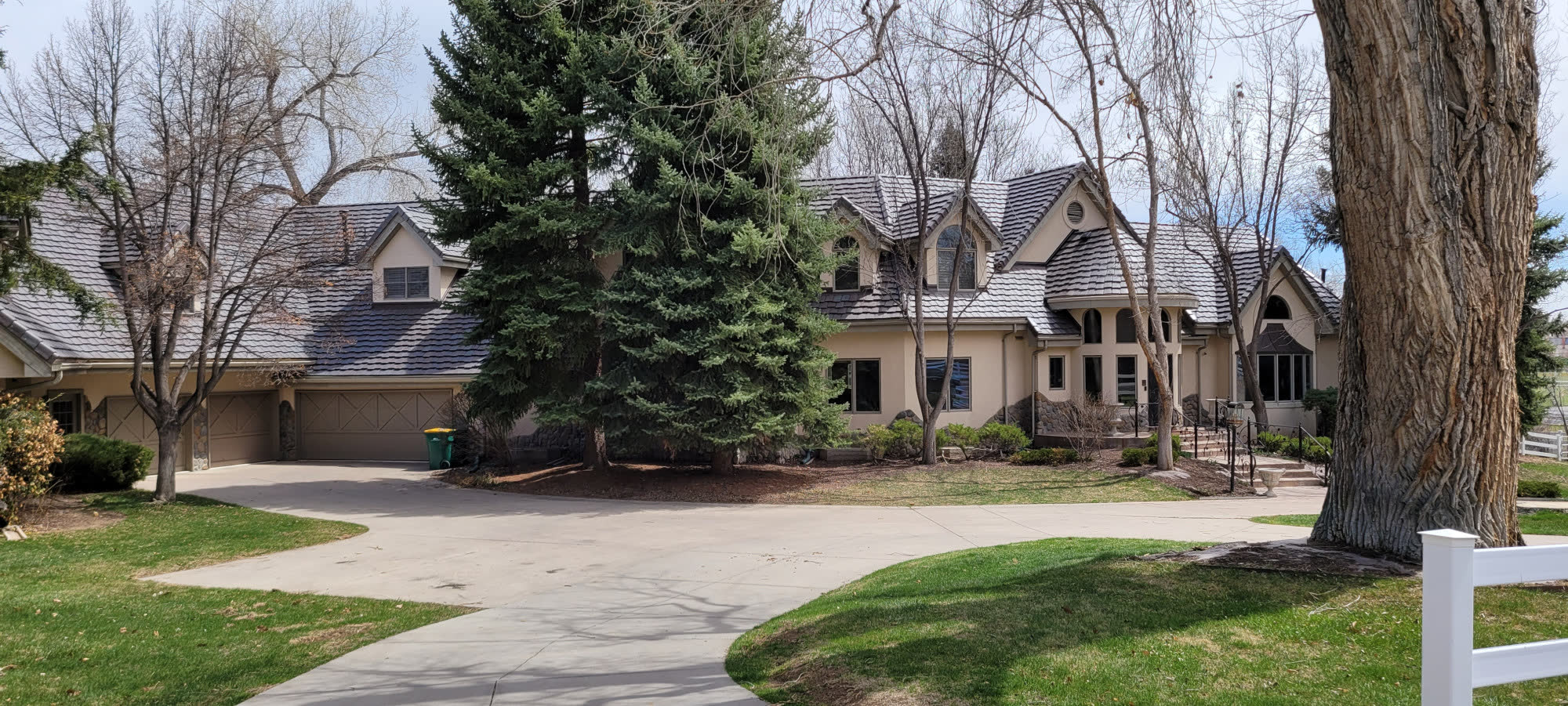
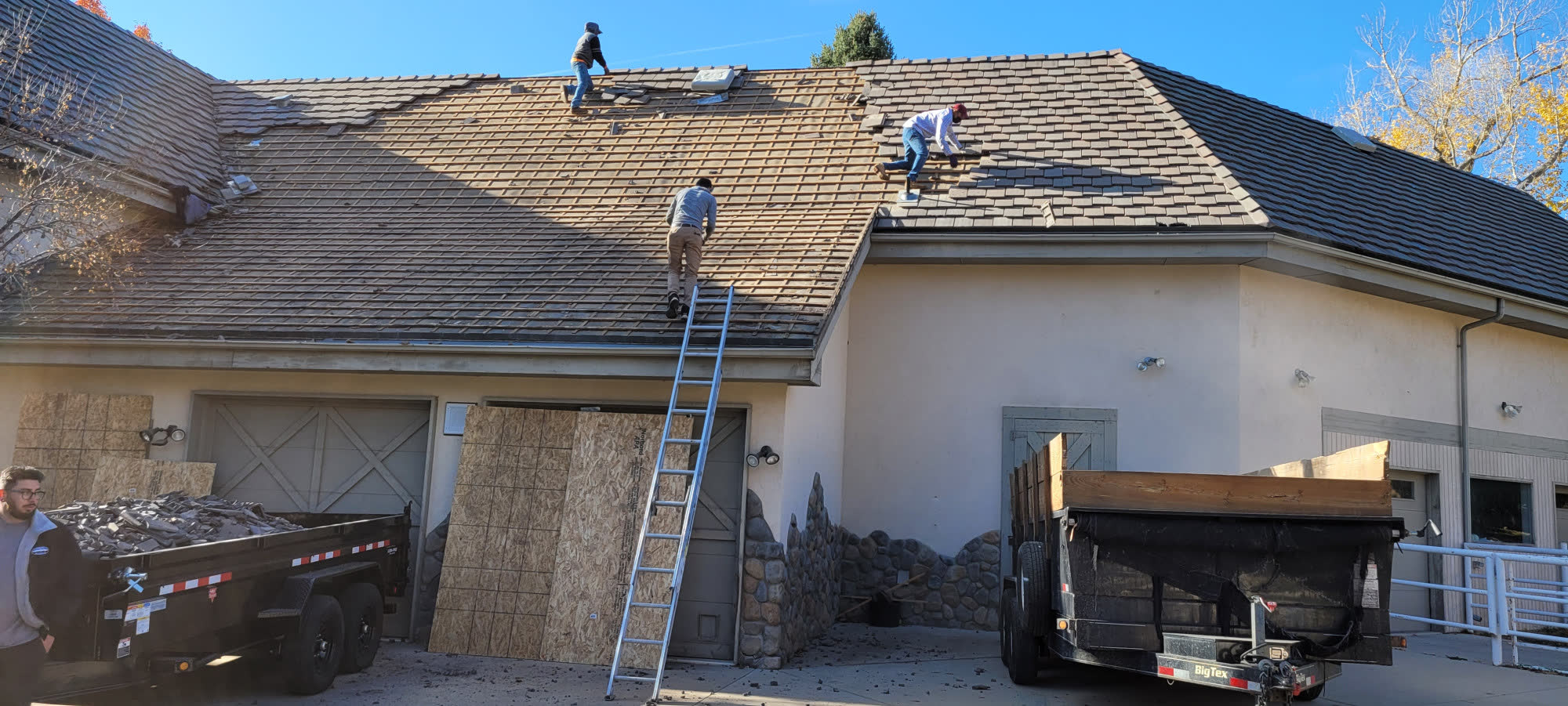
The same roof: existing failed Westile Lightweight concrete tile during tear-off, and the finished Bartile Legendary Shake rough-cut staggered install.
Use mouse, touch, or arrow keys to drag the divider.
250+ Squares of Bartile Legendary Shake, Cherry Hills Village
This luxury estate sits in Cherry Hills Village — one of the most established luxury enclaves in metro Denver. A custom-built estate on a mature lot with extensive stonework, stucco, and the kind of multi-gable roof geometry that tile was made for. The original roof had been installed with Westile Lightweight concrete tile — a product that was known in the industry to be failing, and whose manufacturer eventually shuttered operations ahead of the wave of litigation that was coming. For the homeowner, that meant a roof that couldn't wait — and a replacement window that ran right into winter.
What we put back up there is worth seeing: a custom Bartile Legendary Shake concrete tile installation, laid in a rough-cut staggered pattern so the finished roof reads like hand-split wood shake from the street even though every tile is solid concrete, Class A fire-rated, and engineered for the wind and hail this part of Colorado delivers. On 250-plus squares of roof, that is one of the larger tile re-roofs we have run.
Why the Old Roof Had to Go
Westile Lightweight was one of several concrete-tile products from the late-model era that developed systemic failure modes — spalling, cracking, and edge breakdown that progressed faster than the manufacturer's warranty promised. Homeowners with that product on their roofs faced a deteriorating envelope and, in many cases, a manufacturer unwilling or unable to stand behind the warranty. The Westile company eventually closed its doors; the timing lined up exactly with the wave of legitimate product-defect claims that were moving through Colorado courts.
By the time we were called in to quote, the roof was past "maintenance" — the tile was failing across large sections, and every additional month of exposure risked water intrusion into an extremely expensive envelope. Waiting until spring wasn't an option.
250+ Squares — Commercial-Scale Residential
Most luxury homes we re-roof run 40 to 80 squares. This estate came in at 250+ squares — more than 25,000 square feet of roof surface, spread across multiple gables, dormers, and elevation changes. On tile, that is a project that looks and feels more like a small commercial re-roof than a typical single-family job. Crew staffing, equipment staging, material handling, and debris flow all run at commercial pace and require commercial discipline.
60 Dump-Trailer Loads — The First Week
Concrete tile weighs roughly 900 to 1,100 pounds per square. On 250-plus squares, that is a debris load north of 125 tons of tile coming off the roof — not counting the underlayment, flashings, and batten system that came off with it. We ran six dump-trailer loads per day during the first week of tear-off, with a total debris count of approximately 60 trailer loads over the tear-off phase.
A Genie telehandler staged on site handled the heavy material movement — lifting bundled tile debris off the slopes directly into trailers, then pivoting to lift the new Bartile Legendary Shake bundles onto the roof as the install phase started. That single piece of equipment compressed what would have been days of manual ladder work into efficient cycles and kept the crew focused on the craft instead of the hauling.
Bartile Legendary Shake, Rough-Cut Staggered
Bartile is a premium concrete-tile manufacturer based in Utah. The Legendary Shake line is their answer to real hand-split cedar — varied-edge tiles, multiple thicknesses, and a color blend that reads differently from every angle. The rough-cut staggered install pattern takes advantage of that variety by laying tiles in irregular courses with deliberately non-uniform exposure. Done right, the finished roof looks like aged shake; done wrong, it looks like a tile roof trying to look like shake. The difference is entirely in the hands of the crew doing the cutting and laying.
This installation style is slower than a straight-course tile layout. Each tile has to be selected, cut to complement its neighbors, and placed with an eye on the larger field. On 250-plus squares, that pace choice added real hours to the project — which is part of why the install ran six weeks despite strong crew staffing. The result is a roof you can stand across the circle drive from and read as a $2-million artisan product.
Winter Install — Not a Choice
Tile-on-tile replacement in Cherry Hills Village is ideally a shoulder-season or summer project. In this case, the failing existing roof didn't give us that luxury. We mobilized in late fall and closed out by early spring. Weather delays were baked into the plan — wind windows for crane work, freeze-thaw cycles that affected underlayment selection, and a tarping-and-dry-in protocol that kept the interior protected on days the crew couldn't open new slope.
Insurance + Out-of-Pocket
The project was funded through a partial insurance claim plus a homeowner out-of-pocket contribution following a litigation settlement tied to the defective existing tile. We documented scope, coordinated with the carrier throughout tear-off for the insurance portion, and delivered a complete warranty packet — both the Bartile manufacturer warranty and our workmanship warranty — at closeout.
Bartile Legendary Shake — Concrete That Reads Like Cedar
Bartile is a Utah-based premium tile manufacturer whose Legendary Shake line delivers hand-split cedar aesthetics at concrete-tile durability — Class A fire, 150+ mph wind, freeze-thaw stability, and color-through pigmentation that holds against UV. The rough-cut staggered install method we used on this estate is how the product shows at its best: varied tile widths, staggered exposures, and color blending that breaks up the repeating pattern most tile roofs carry. This is an artisan installation style that takes additional crew hours but delivers a roof that stands out in a neighborhood of high-end estates.
Failed Tile or Planning a Premium Re-Roof?
If your home has a Westile Lightweight roof, or any concrete tile system that's showing spalling, cracking, or edge failure — we'll walk it, document the condition, and put together a written scope for replacement. Bartile, Eagle Roofing, Boral (now Inspire), and clay options all on the table.
Get a Free Estimate 855 ROOF-001