- Call Us Today! 855 ROOF-001
- Email: info [at] RoofTechnologies.com

Residential Storm Claims, Documented Honestly
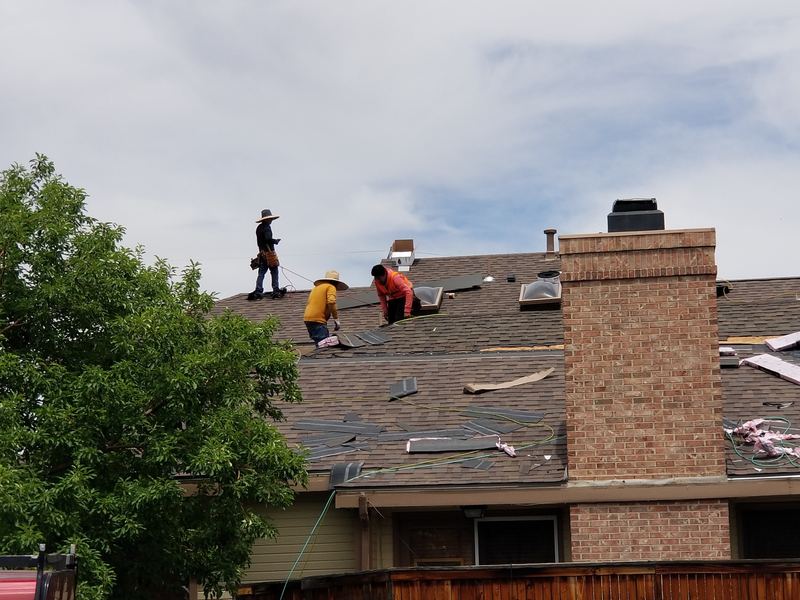
Colorado, Kansas, Missouri, Nebraska, and Wyoming are hail country. Every year, storms come through and leave behind roofs, siding, gutters, AC units, fences, and garage doors that will need to be replaced on insurance. Our job on a residential claim is to document what is actually there — not to inflate the scope, and not to let the carrier miss what they are obligated to cover. Straight work, straight scope, straight paper trail.
What We Actually Do on a Residential Claim
A roofing contractor is not a public adjuster and cannot negotiate a claim on the owner’s behalf — that would be unauthorized practice in most states. What we can do is document the damage properly, write an accurate scope, meet the carrier’s adjuster on-site, and supplement the claim when the initial scope misses something.
- On-site damage inspection with chalked test squares, photos of each slope, and attic-side water-intrusion documentation where applicable.
- Written scope of loss built to the standard line items insurance carriers recognize.
- Adjuster meeting — we walk the roof and the property with the carrier’s adjuster so they see what we saw.
- Supplement support if, during tear-off, we find damage that wasn’t visible from above (rotted decking, underlying layers, code-required upgrades).
What a Residential Hail Claim Usually Covers
For a single-family home after a hail storm, the claim usually covers the roof, gutters, window screens, and often paint or siding depending on the size of the hail and the direction of the wind. AC condensers, fences, garage doors, and skylights get added as we find damage. We organize all of this into one coordinated claim so you aren’t juggling multiple contractors and scopes.
- Single-point coordination across roof, gutters, siding, paint, AC, fence, garage, and interior.
- Code upgrade documentation — ice-and-water, drip edge, ventilation upgrades your policy should cover.
- ACV-to-RCV recovery guidance so depreciation gets released when the work is completed.
- Mortgage-company handling on larger losses where the check is issued to the owner and the bank.
- Class-4 shingle upsell documentation if you want to upgrade to impact-rated material during the replacement — often the only out-of-pocket cost is the material upgrade itself, and the insurance premium discount pays back the upgrade in 3–5 years.
Deductibles, Depreciation, and What Your Check Actually Pays
Most residential policies pay the loss on a Replacement Cost Value (RCV) basis, issued in two parts:
- ACV (Actual Cash Value) check up front — the RCV minus depreciation minus your deductible. This is what you get when the claim is first approved.
- Depreciation (recoverable) check released after the work is complete and the invoice is submitted — this is the difference between ACV and full RCV.
Your deductible is yours to pay. A legitimate contractor cannot “waive” or “eat” a deductible — doing so is insurance fraud in every state. If a contractor offers, walk away.
Common Residential Claim Pitfalls
- Filing a claim for damage the carrier won’t cover. If the hail was cosmetic and the shingles still pass the mat test, a claim may close zero and count against your claim history. We inspect first and tell you honestly whether a claim is worth filing.
- Missing the supplement window. Carriers typically have a stated time window for supplement requests after tear-off. We build the supplement packet while the roof is open, not after it’s closed.
- Settling on ACV and forgetting depreciation. If the work never gets completed, the depreciation check never gets released — that can be thousands of dollars left on the table.
Assignment of Benefits (AOB) — What It Is and Why We Use One
When you hire us for a storm-damage claim, we ask you to sign an Assignment of Benefits — an agreement that assigns your insurance claim rights for the project to us for the duration of the work. It sounds bigger than it is. Here is what it actually does, and why it is in your interest rather than against it:
- Legal standing to invoke appraisal. Most homeowner policies include an appraisal clause — a faster and cheaper alternative to litigation when you and the carrier disagree on the scope or the dollar amount. Only the policyholder or the assignee (us, via the AOB) can invoke that clause. Without the AOB, you would either invoke it yourself (which is a formal process most homeowners never want to run on their own) or hire an attorney at 33–40% contingency. With the AOB, we handle it at no additional charge, because we have a direct interest in getting the scope right.
- Direct communication with the carrier. The AOB lets us write supplements, submit documentation, and walk the roof with the adjuster in our own name — so you are not relaying every conversation through your inbox and trying to translate roofing terminology you never asked to learn.
- Legal remedies if the carrier acts in bad faith. If a carrier unreasonably denies or underpays, the AOB gives us the standing to pursue the scope — mediation, small claims, or full litigation when warranted — instead of you having to hire a plaintiff’s attorney to do it at your own expense.
- The check still goes to you. The carrier issues payment to you (and your mortgage company, if applicable) the same way it always would. We invoice you for the contracted scope; you pay from the claim proceeds plus your deductible. The AOB gives us process authority to pursue the claim — it does not redirect your check.
- Statutory cancellation window. Every state we work in (Colorado, Kansas, Missouri, Nebraska, Wyoming) provides a written cancellation window on residential construction contracts — typically three business days after signing. You can walk away during that window, no questions asked.
Common AOB Questions
- Does an AOB mean I lose control of my claim? No. You remain the policyholder and the named insured. The AOB gives us the legal standing to pursue the scope on the roofing work — it does not transfer your coverage, your policy, or your right to cancel the project.
- Can the contractor spend my insurance money on other things? No. The carrier issues the check to you (and your mortgage company if applicable), not to us. We invoice you for the contracted scope and you pay from the claim proceeds plus your deductible — exactly like any other contractor.
- What if I change my mind? You have the statutory three-business-day cancellation window on the residential contract and the AOB. Beyond that, the construction contract has its own termination terms.
- Does the AOB cost me extra? No. Our fee is the scope in the written contract. The AOB lets us do the claim documentation, appraisal invocation, and (if ever needed) legal pursuit of the scope at no additional cost to you.
- Why do other people say AOBs are dangerous? Because a broad, vague AOB from a bad actor can be dangerous. Florida and a few other states saw abuse of AOBs by contractors who used them to submit inflated claims or redirect homeowner checks. Our AOB is a written, state-compliant document with a cancellation window and scope tied to the roofing contract. The right question is not “should I ever sign an AOB?” but “what does this specific AOB actually say, and does my contractor stand behind it?” We’ll walk you through ours line by line before you sign.
What We Will Not Do
We will not manufacture damage. We will not encourage you to file a claim that isn’t supported. We will not participate in a claim that involves inflating scope to pay your deductible — that’s insurance fraud, and it ends careers. A contractor who waives your deductible is also telling you something about how the rest of the job will be run.
Commercial, HOA, or Multi-Family Property?
Commercial and HOA claims run on a different paperwork track — drone surveys, moisture scans, core sampling, and building-by-building scope packages. See our Commercial Insurance Claims page for how we document those.
Schedule a Residential Claim Inspection
If a storm came through and you’re not sure if you have a claim, or you’ve filed one and the scope doesn’t look right, we’ll come out, walk the property, and give you a straight answer about what’s there.
Call us at 855 ROOF-001, email info [at] rooftechnologies.com, or submit a request through our contact form to schedule a claim inspection.
Still have questions? Contact us
Hail Damage Roofing by City
Deeper, city-specific hail claim support — 2018 storm supplements, local carrier discounts, county permit coordination, and neighborhood-specific hail history.
Full Insurance Claim Support & Specialty Rebuild
All-peril claim support (wind, tree, fire, ice dam, vandalism) plus specialty rebuild work for post-wildfire reconstruction.
Insurance Claims FAQ
Common questions about the storm-damage insurance claim process in Colorado, Kansas, Missouri, Nebraska, and Wyoming.