
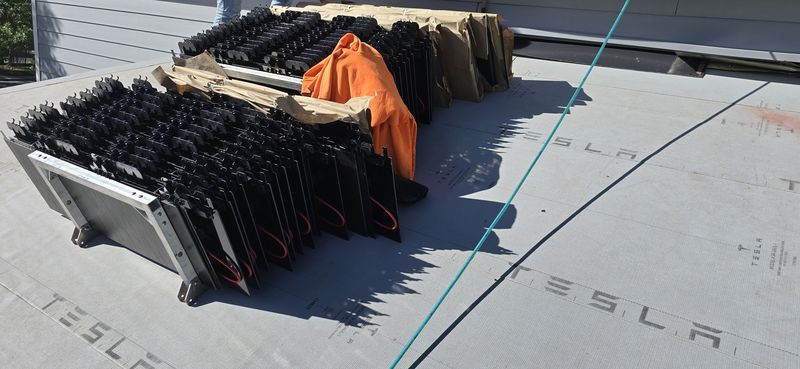
Solar owners with a hail-damaged roof learn quickly that the solar array adds a layer of coordination that a non-solar homeowner does not have to think about. The roof has to come off, the solar array has to come with it, and both have to go back on in the right sequence. Here is how the logistics, costs, warranties, and insurance actually work in practice.
The Short Version
If your roof needs replacement, the panels come off first, the old roof comes off, the new roof goes on, and the panels go back on top. The solar removal and reinstall (R&R) is typically done by a licensed solar contractor, not the roofer. Cost ranges are $2,000 to $5,000 for a residential 8 kW to 15 kW array, and most insurance policies cover the R&R when a covered peril caused the roof damage. Expect the overall project to take 2 to 4 weeks from solar removal through final inspection.
Why the Solar Contractor Has to Do It
Roofers are licensed for roofing. Solar contractors are licensed for electrical work and PV system commissioning. The disconnect and reconnect of a live PV system is electrical work and requires electrical permits in Colorado, Kansas, Missouri, Nebraska, and Wyoming. Most roofing contracts explicitly exclude solar R&R because the work is outside the roofer's license scope.
A handful of roofing companies (including us on select projects) have in-house solar-qualified crews, but even then the work is performed under a solar electrical license, not a roofing license. The two scopes are separate, priced separately, and permitted separately.
What the Cost Covers
A typical $3,500 R&R on a 20-panel residential array includes:
- Site visit and system documentation.
- Production data snapshot before removal (for monitoring continuity).
- Electrical disconnect and lockout.
- Panel removal, wiring disconnect, racking removal.
- On-site storage of panels and racking during the re-roof.
- New roof penetration flashings (replacing the old flashings from the original install).
- Racking reinstall with new flashings or sealed penetrations.
- Panel reinstall, wiring reconnection, system commissioning.
- Inspection coordination with the AHJ and the utility.
- Monitoring re-sync and production verification.
Costs scale roughly with array size: 20-panel systems around $2,500 to $3,500, 30-panel systems around $4,000 to $5,000, larger systems priced per panel. Tesla Powerwall or battery storage adds coordination complexity and cost.
Insurance Coverage for the R&R
When the roof damage is from a covered peril (hail, wind, falling objects), nearly every Colorado, Kansas, Missouri, Nebraska, and Wyoming homeowner policy covers the solar R&R as part of the claim. The line item is typically included in the adjuster's scope under "solar panel removal and reset" or similar language.
A few nuances:
- The carrier will usually want a documented quote from the solar contractor for the R&R work. Have your solar installer quote this in writing before you finalize the claim scope.
- If the array itself was damaged (hail cracks on panels, fried microinverters), that is a separate claim line and the panels are priced individually.
- Leased or PPA-owned systems add a layer of coordination. The leasing company (Sunrun, SunPower's financing arm, etc.) has to authorize the R&R, and their contractor may need to perform the work. This adds time but is usually straightforward.
- If the original solar install came with a roof penetration warranty, that warranty may cover some of the flashing work at R&R time. Check the original solar contract.
Sequencing and Timeline
A well-coordinated re-roof under a solar array follows this sequence:
- Week 1: Solar contractor visits, documents system, generates R&R quote.
- Week 2: Insurance claim finalized with R&R line item included.
- Week 3: Solar contractor removes array. Panels and racking stored on a secure staging area.
- Week 3 (same week): Roofer tears off old roof, installs new system. Typical 2 to 3 working days.
- Week 3 or 4: Solar contractor returns to reinstall racking, panels, and electrical.
- Week 4: Electrical and building inspections. Utility re-energizes the system.
- Week 4: Monitoring re-sync and production verification.
The time-critical piece is the gap between solar removal and solar reinstall. Most solar contractors can schedule this within a few days of each other if the roofer hits their schedule. Delays on the roof side (weather, material backorder, supplement approvals) cascade into the solar side.
Warranty Impact
The solar warranty has two layers: the panel manufacturer warranty (typically 25 years on performance, shorter on workmanship) and the installer workmanship warranty (typically 10 to 25 years depending on the installer).
R&R generally does not affect the panel manufacturer warranty. It can affect the installer workmanship warranty if the original installer is not the one performing the R&R — the new contractor becomes responsible for their own work, and the boundary between old and new responsibility gets murky.
Best practice: if the original installer is still in business and reasonable to work with, hire them for the R&R even if they charge slightly more. The warranty remains clean, any issues trace to one responsible party, and monitoring and service go through a single vendor.
Common Mistakes to Avoid
Scheduling the Roof Before the Solar R&R Is Locked In
A new roof scheduled for next Tuesday with no solar contractor booked is a stalled project. Solar removal needs to happen before the roofer arrives. Get the solar R&R scheduled first and schedule the roof around it, not the other way around.
Assuming the Roofer Will Flash the Solar Mounts
Roofers flash the roof. Solar mounts are flashed by the solar contractor when they reinstall the array. A common miscommunication is the roofer assuming the solar company will flash the mount points, and the solar company assuming the roofer did it. Confirm the scope split in writing before either crew starts.
Not Insuring the Panels During Storage
Panels sitting on pallets in the driveway for two weeks are a theft and damage risk. Confirm that the solar contractor's liability insurance covers the panels during storage, or that your homeowner's policy does, and that they are stored in a locked or secured area.
Forgetting About the Utility Re-Energization
After the array is reinstalled, the utility (Xcel in Denver, Evergy in KCK, Black Hills in southern Colorado, etc.) has to inspect and re-energize the system before it can produce power. This adds a few days to a few weeks depending on the utility's schedule. Plan for it.
Should You Upgrade the Array at Re-Roof Time?
If your array is more than 8 years old, re-roof time is the natural moment to think about upgrades. Panel efficiencies have improved meaningfully since 2015, and the cost of newer panels is lower than it was when your original array was installed. A full re-array with new panels on the new roof is not always economic, but running the numbers is worth doing.
Similarly, adding battery storage (Tesla Powerwall, Enphase IQ Battery, FranklinWH) is logistically easier when the roof and electrical work are already underway. If you have been thinking about a battery, re-roof time is the right trigger.
Related Reading
Have Solar and Need a New Roof?
We coordinate solar R&R with trusted Colorado, Kansas, Missouri, Nebraska, and Wyoming solar contractors as part of every storm-claim re-roof. One point of contact for the entire project.
Schedule a Coordinated Estimate or call 855 ROOF-001