
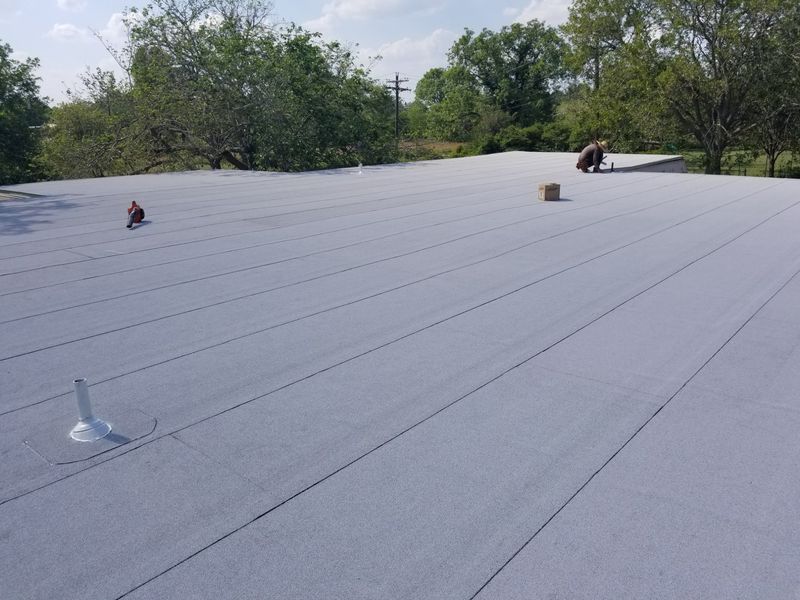
Every emergency-call commercial roof leak we respond to in January and February traces back to an item that would have been visible and preventable on a September or October inspection. A fall commercial roof inspection is the single cheapest insurance policy a property manager can buy, and the budget line is trivial compared to the cost of a mid-January water intrusion into an office, warehouse, or retail tenant space.
Here is the 8-point inspection we perform for enrolled buildings before first frost.
1. Drains, Scuppers, and Overflow Outlets
Every drain, every scupper, every overflow. A blocked drain in winter means water backs up and freezes, which lifts the membrane, splits at the drain bowl, and creates interior leaks.
Inspection items:
- Drain strainer is clean and in place.
- Drain bowl interior is clean, no sediment or nesting material.
- Overflow scuppers are clear and unobstructed.
- Drain collars are tight, no visible tear or lift at the membrane.
- Downstream plumbing is clear (confirmed with a water test if feasible).
2. Membrane Seams Across the Entire Roof
Every seam on every slope. TPO and PVC seams are heat-welded; EPDM seams are adhesive-tape joined. Summer heat and UV accelerate seam stress. Fall is the last opportunity to find seam failures before freeze-thaw cycles widen them.
Inspection items:
- Probe every seam with a seam probe (a flat metal pick) to find marginal welds.
- Look for "fishmouths" (small openings where the seam is not fully welded at the edge).
- Check for membrane shrinkage pulling seams tight at corners and terminations.
- Verify T-joints (where three pieces of membrane meet) are properly detailed.
Any marginal seam found gets re-welded or repaired on the spot.
3. Base Flashings and Penetrations
Base flashings at parapets, walls, and penetrations are the most common source of commercial roof leaks. The fall inspection covers:
- Every parapet base flashing, front and back edge.
- Every pipe, conduit, and vent penetration.
- Every HVAC curb, including the flashing under the unit.
- Every drain, scupper, and overflow outlet flashing.
- Every skylight curb and dome.
- Every roof hatch.
Issues found are tagged with photos, given a repair priority, and either fixed during the inspection or scheduled for follow-up.
4. HVAC Units and Equipment
Rooftop HVAC is the highest-cost-per-claim area on most commercial roofs. Fall inspection items:
- HVAC curb flashing condition.
- Condensate line discharge location (is it draining to the membrane or into a drain?).
- Gas line supports and sealant at penetrations.
- Electrical conduit straps and flashing.
- Disconnect switch enclosures for water intrusion.
- Equipment pad condition.
A condensate line discharging freely onto a membrane creates a perpetual wet zone that freezes in winter and accelerates membrane failure. Redirecting the discharge into a drain or scupper is a quick fix with major long-term benefit.
5. Walkway Pads and Service Paths
Walkway pads protect membrane from traffic damage. Damaged or missing pads lead to foot traffic directly on the membrane during winter service calls.
Inspection:
- Walkway pads still adhered and in position.
- No missing sections creating direct-membrane traffic zones.
- Path continues to all equipment requiring service.
Replacement pads are inexpensive and installed during the inspection.
6. Ponding and Drainage
Ponding areas are both a sign of drainage issues and a source of winter damage. Water that ponds in October freezes in December, expands, and distresses the membrane.
Inspection:
- Map ponding areas on a roof plan.
- Verify drains are at the lowest point of each drainage area.
- Check for staining that indicates long-standing ponding.
- Identify areas where tapered insulation could eliminate the ponding in a future restoration project.
7. Interior Ceiling and Tenant Space Signs
Even with no reported leaks, the inspection includes a walk through interior spaces looking for:
- Ceiling tile stains indicating intermittent leaks.
- Water-damaged drywall at the roof line.
- Mildew odor in closets and storage areas.
- Nail pops or drywall cracks suggesting attic-side moisture.
A small ceiling tile stain that the tenant has not reported may be the first sign of a larger problem that will manifest fully in a winter rain.
8. Documentation Package
The inspection deliverable is a written report with:
- Photographs of every slope, penetration, and repair item.
- A roof plan showing drain locations, equipment, and ponding areas.
- A priority-ranked list of repair items with costs.
- A narrative condition summary.
- Recommendations for the next 12 months.
This report is what property managers need for reserve planning, board reporting, and insurance documentation. It is also what separates a proactive owner from a reactive one when a storm hits.
What the Inspection Costs vs. What the Alternative Costs
A professional fall commercial roof inspection for a 50,000 sqft building typically runs $500 to $1,500 depending on complexity, and an enrolled maintenance program bundles the inspection at no additional cost. Compare to:
- An emergency winter service call: $2,500 to $8,000 for immediate leak response.
- Interior damage remediation after a winter leak: $15,000 to $150,000 depending on tenant build-out and inventory.
- Business interruption for a tenant displaced by a leak: $5,000 to $100,000 depending on tenant size.
The inspection is cheap insurance. Skipping it is gambling with tenant relationships and insurance deductibles.
When to Schedule
In Colorado, Kansas, Missouri, Nebraska, and Wyoming, schedule the fall inspection between September 15 and October 15. Earlier than that and summer storm damage may not have fully manifested; later than that and a sealant repair will not cure reliably before cold weather.
Enrolled buildings in our Commercial Maintenance Program are scheduled automatically on an annual cycle, with fall inspections concentrated in September and the first two weeks of October.
Related Reading
Schedule Your Fall Commercial Inspection
We inspect commercial roofs across Colorado, Kansas, Missouri, Nebraska, and Wyoming every September and October. Documented photographic report, prioritized repair list, no obligation.
Schedule an Inspection or call 855 ROOF-001