
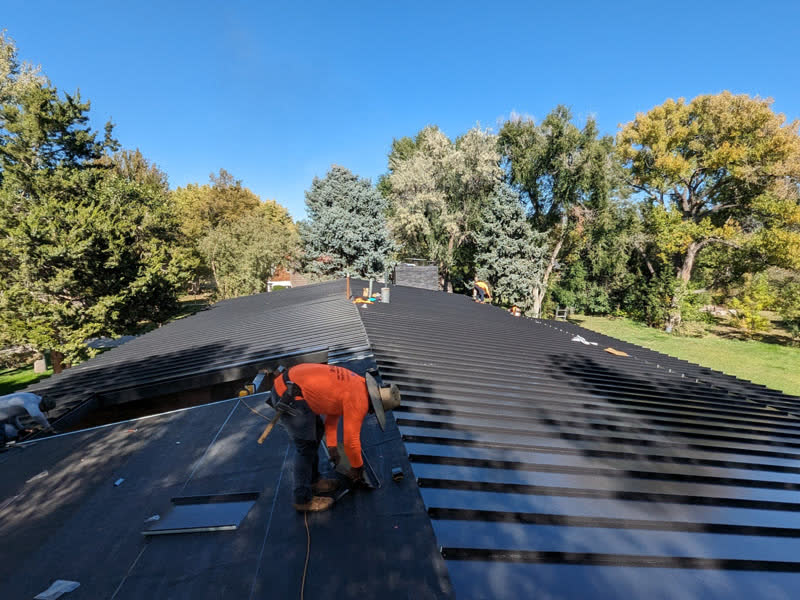
Standing-seam metal sheds snow well. That is the design feature that sells homeowners on it, and it is also the failure mode nobody warns them about. A foot of accumulated snow on a 6:12 standing-seam roof, hit by an afternoon sun in February, releases as a single sheet — sometimes 2,000 pounds at once, sometimes 4,000. It lands on whatever is in front of the eave. That includes decks, skylights below, parked cars, vent stacks on lower roof sections, and occasionally people.
Snow guards stop or slow that release. The question is when they are required, when they are good practice, and when they add cost without adding value. In Colorado, the answer depends on roof slope, what is below the eave, and which kind of metal roof you have.
Three Common Metal Roof Types and How They Shed
Different metal profiles shed snow differently, and snow-guard requirements track those differences:
- Standing seam (Galvalume or coated steel) — the smoothest profile in residential use. Mechanical-lock or snap-lock seams provide no friction for snow to grab onto. A glazed snow layer on a standing-seam roof will release in one slab. Standing seam almost always benefits from snow guards in Colorado.
- R-panel / corrugated — the ridges and valleys of an R-panel give snow some friction. R-panel still sheds, but more gradually and in smaller chunks. Snow guards are sometimes used, often skipped on commercial buildings without people-traffic concerns. R-panel roofs over warehouses and barns rarely use them.
- Stone-coated steel — the surface granules dramatically increase friction. Stone-coated stone-coated steel sheds slowly and in chunks, much like a Class 4 asphalt shingle. Snow guards are usually not required and are uncommon in residential installs.
That ordering matters because the snow-guard recommendation is "almost always" for standing seam, "case by case" for R-panel, and "rarely needed" for stone-coated. Generic statements like "metal roofs need snow guards" gloss over a real difference.
When Snow Guards Are Non-Negotiable
Several conditions tip a standing-seam project from "good practice" to "must have":
- An entry door, deck, or walkway under the eave. Falling snow has killed people in Colorado mountain towns. The risk is small but it is real. We never install standing seam over an entry without snow retention.
- A lower roof section directly below. Common on multi-pitch homes — a steep upper slope dumping onto a 4:12 lower slope can damage the lower roof and clog gutters. Snow guards on the upper section, sometimes paired with a snow fence at the eave.
- HVAC equipment, vents, or solar panels on a lower roof. A snow slide hits a vent boot or a panel rack and the damage is immediate. Snow guards above any roof equipment.
- A driveway or walkway under the gable end. If the snow shed lands where someone parks or walks, retention is required by basic liability standards even if not by code.
- Steep slopes above 8:12. Shed velocity scales with pitch. Above 8:12, even small accumulations can shed dangerously. This is most common on Tahoe-style gable roofs in mountain communities.
- Mountain elevations above 7,500 feet. Heavy snow loads make any release a structural and personal hazard. Most mountain HOAs and some building departments require retention systems.
When Snow Guards Are Over-Engineering
If none of the above apply, snow guards may not be worth the cost. Cases where we typically recommend skipping:
- R-panel or stone-coated steel with no equipment or traffic below — the surface friction handles the shed naturally.
- Low-slope standing seam under 4:12 — snow tends to melt in place rather than shed in slabs.
- Eaves that face open lawn or landscaping with no walkway or vehicle below — a controlled shed onto bare ground is what the roof was designed to do.
- Detached garages or outbuildings where no one stands at the eave during winter.
Adding snow guards "just in case" on a residential standing-seam roof costs $400 to $1,800 per gable depending on width and guard system. That is not a lot of money in absolute terms, but it is also not free, and it is wasted if the conditions do not warrant it.
Pad Style vs. Pipe Style vs. Snow Fence
Three main retention systems, suited to different conditions:
Pad-style snow guards (sometimes called pads, cleats, or polycarbonate guards) are individual triangular pieces that mount to standing-seam ribs. They break a single snow slab into many smaller pieces. Each pad holds maybe 50 pounds of snow load. They are the lowest cost option and they look minimal from the ground. They work well for moderate slopes (4:12 to 7:12) and moderate snowfall. Spacing depends on slope, panel width, and snow load — typically two to three rows staggered across the bottom 18 to 30 inches of the slope.
Pipe-style snow guards (also called pipe rails or snow rails) are continuous horizontal pipes mounted on standing-seam clamps that span the entire eave. They hold the snow as a single mass against the rail rather than breaking it apart. Higher capacity, higher visibility, higher cost. Pipe-style is the right choice for steeper slopes (above 7:12), heavier mountain snow loads, and any eave where keeping snow ON the roof through a controlled melt is preferable to letting smaller chunks slide.
Snow fences are a heavier-duty version of pipe-style — multiple horizontal rails plus vertical pickets, capable of holding several feet of snow against the eave. Used on commercial buildings, mountain residential at high elevation, and any eave above an entry where zero shed is the goal.
Mounting matters more than people realize. Snow guards on standing seam should ALWAYS clamp to the seam, never penetrate the panel face. Glued or adhesive-mounted polycarbonate guards exist and they work for several years, then they fail in a heavy melt cycle. Mechanical clamping to the seam is the only system we install on a real Colorado snow load.
Code, HOA, and Insurance Considerations
Most Colorado building codes do not specifically require snow guards on residential metal roofs, but several mountain jurisdictions (Summit, Eagle, Pitkin, Park, parts of Routt) have local amendments or HOA rules that do. If you are in a mountain community, check your covenants before assuming it is optional.
Insurance carriers do not typically discount for snow guards. A few specialty mountain-property insurers do consider them a positive underwriting factor, but the difference is small. The real insurance angle is liability — if a snow shed from your roof injures a delivery driver or a neighbor, your homeowner liability coverage will respond, but a documented preventable hazard (no guards above an entry, multiple prior incidents) can affect your renewal.
For other metal-roof topics, see asphalt vs metal vs tile cost and hail damage on metal roofs.
What We Spec for a Front Range Standing Seam
A typical Front Range residential standing-seam project, 5,500 to 7,500 feet elevation, with a deck off the back and an entry under one gable, gets:
- Two staggered rows of pad-style guards above the deck-side eave — enough to break the slab without imposing pipe-rail aesthetics on the architecture.
- One pipe-style rail above the entry — full retention, zero shed onto the front walkway.
- No retention above the gable end facing open lawn — the shed onto landscaping is intended.
- Pad-style guards above HVAC condensers if any are within the shed footprint of the upper roof.
Snow guards are part of the project conversation we have at the contract stage on every standing-seam install, not a line item that gets value-engineered out at the end. If you are getting bids on a metal re-roof and snow retention is not in the scope, ask the contractor why before signing.
Standing Seam, Stone-Coated, or R-Panel?
We install all three across Colorado, Wyoming, and the Kansas City metro. Snow retention specs and pitch-and-snow-load calculations are part of every estimate.
Get a Metal Roof Quote or call 855 ROOF-001