
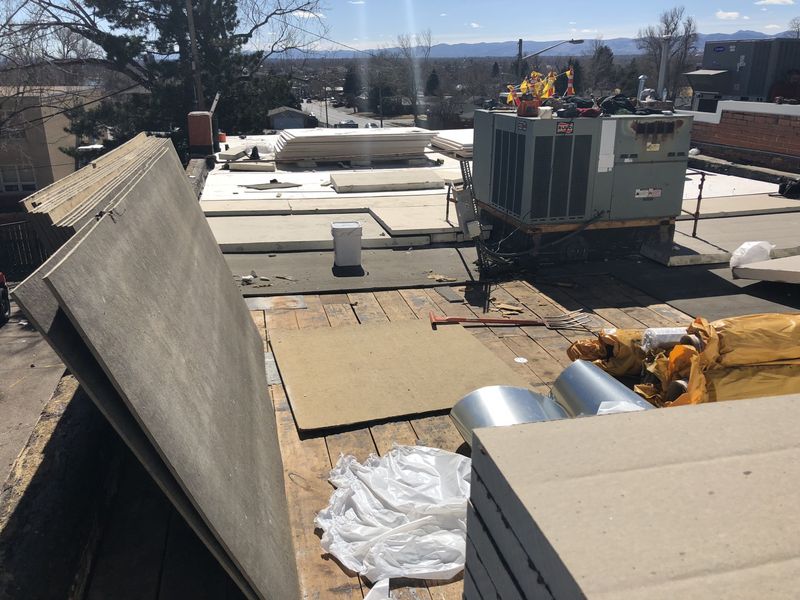
Every commercial roof spec sheet says the membrane is hail-rated. The rating matters, but it is not the same thing as how the membrane actually behaves when a Colorado supercell drops golf-ball-sized stones for twelve minutes straight. After two decades of inspecting commercial roofs on the Front Range after hail events, we have seen which membranes hold up and which do not.
From our field experience: PVC damages easiest under hail, TPO sits in the middle, and older EPDM holds up surprisingly well. That is not the industry sales pitch. It is what the roofs look like the week after a major storm.
Here is the full comparison, with the context that explains why the pattern is what it is.
The Three Membranes, Briefly
TPO (Thermoplastic Polyolefin)
The most commonly-specified commercial membrane in the last decade. Typically white, heat-weldable seams, 45 to 80 mil thickness. Popular because it is cheaper than PVC, easier to install than EPDM, and reflective (good for cooling loads).
EPDM (Ethylene Propylene Diene Monomer)
The long-standing dark rubber membrane. Usually black, typically 45 to 90 mil, joined with adhesive tape or bonding adhesive rather than heat-welded. Has been on commercial roofs in the US for 40+ years with well-understood long-term performance.
PVC (Polyvinyl Chloride)
A heat-weldable thermoplastic membrane similar to TPO in installation method, but chemically different. Strong chemical resistance, which is why it is popular on restaurant roofs (grease exposure) and industrial buildings (chemical exhaust). Typically 50 to 80 mil.
What We See After a Hailstorm: The Field Pattern
PVC: Damages Easiest
PVC becomes increasingly brittle as it ages. The plasticizers that keep PVC flexible migrate out of the membrane over time (typically 10 to 15 years depending on thickness and exposure), and the membrane loses impact resistance. Under hail, aged PVC can crack at hit points, split along seams where it has hardened, and shatter at detail flashings.
On 15+ year old PVC roofs we inspected after the June 2018 and May 2023 Front Range storms, fracture damage was the dominant failure mode. Even stones that only dented TPO on the adjacent building cracked through aged PVC. The membrane's chemical-resistance advantage, which is its main reason to be specified, is not a hail advantage.
Newer PVC (under 10 years) performs much better, but the service-life curve for hail resilience is steeper than either TPO or EPDM. A 20-year PVC roof in a Colorado hail ZIP is a claim waiting to happen.
TPO: Middle of the Road
TPO's hail performance is heavily dependent on thickness and age. A 60 or 80 mil TPO roof under five years old will take a substantial hail hit with just surface bruising and recover with no claim required. The same membrane at 15 years and 45 mil will see punctures and seam failures in the same storm.
The specific TPO failure pattern we see post-storm:
- Direct hits cause bruising that is visible but not immediately a leak.
- Over the following weeks and months, the bruised areas develop stress cracks as the membrane flexes through daily thermal cycles.
- Seams near penetrations pull apart at joints that were marginal before the storm.
The post-storm inspection on a TPO roof has to include a carefully examined seam check and a bruise-area documentation. Carriers are used to the pattern and will cover replacement when the bruising density is documented properly.
EPDM: Holds Up Surprisingly Well
The big surprise for most building owners is that the oldest, cheapest-sounding commercial membrane is often the best hail performer. EPDM is a cured rubber, not a plastic, and it has a more favorable deformation-to-recovery curve under impact. Hail hits EPDM and the membrane flexes, absorbs the energy, and returns to shape. The same stone that cracks aged PVC and bruises TPO usually leaves EPDM with no functional damage.
The failure modes that do show up on EPDM after hail are almost always at the seams and flashings rather than in the field. Adhesive tape seams that were marginal before the storm can split under impact. The membrane itself comes through surprisingly well.
This is not an endorsement of EPDM for every project. EPDM is darker (higher cooling load in summer), harder to find skilled installers for in certain markets, and does not weld into a detail as cleanly as TPO or PVC. But for a building owner prioritizing hail resilience, EPDM deserves serious consideration, particularly in the 60 and 90 mil thicknesses.
Thickness Matters More Than Brand
A 45 mil TPO roof is a different product than an 80 mil TPO roof under hail, and the same applies to PVC and EPDM. For any building in a Colorado or Kansas hail ZIP, 60 mil should be the minimum spec and 80 or 90 mil is the right choice for roofs that carry significant occupancy or inventory value.
The incremental cost of 80 mil over 45 mil on a typical commercial re-roof is small (usually 15 to 25 percent of the membrane line, and less than 10 percent of the total project cost). The reduction in hail-claim frequency and severity is considerably larger.
The Underlayment and Cover Board Decision
Under any membrane, the cover board absorbs a meaningful fraction of hail energy. The upgrade from no cover board to a dense fiberboard or high-density polyiso cover board is one of the most cost-effective hail-resilience investments available, and it applies equally to TPO, EPDM, and PVC systems.
Similarly, a thicker insulation stack below the membrane reduces the deflection that transmits impact energy to the membrane. Both are worth specifying in hail country.
The Warranty Question
Manufacturer warranties on commercial membranes typically cover manufacturing defects and certain installation failures, but not hail damage. Hail is almost always excluded from the manufacturer warranty and handled entirely through the property insurance policy.
Hail warranties are offered as an add-on by some manufacturers (Carlisle, GAF, Firestone all have versions) and typically provide extended membrane-replacement coverage for hail hits above a defined size. These are worth considering on higher-value buildings, but read the exclusions carefully. Many require specific cover board, thickness, and attachment specs.
What We Spec for New Commercial Work in Hail Country
Our default specification for a new re-roof on a Front Range commercial building, absent other constraints:
- Membrane: 80 mil TPO for standard buildings, 90 mil EPDM for buildings where hail resilience is the priority over solar reflectance, 80 mil PVC only where chemical exposure requires it.
- Cover board: High-density polyiso or dense fiberboard, fully adhered.
- Insulation: Adequate R-value per code plus a tapered system to eliminate ponding.
- Seams: Double-welded where specified by the manufacturer for the hail warranty.
- Drains and edges: Full-thickness membrane with reinforced detail at every penetration.
These specs are not the cheapest way to put a roof on a building. They are what actually survives the next hail event with minimal claim exposure.
Retrofitting an Existing Roof Mid-Life
If you have an aged PVC or 45 mil TPO that has survived several hail seasons already, the question is whether to wait for the next storm (and let insurance drive a replacement) or proactively upgrade. Our answer depends on the roof's remaining life and the building's insurance exposure. We cover the silicone restoration option for aged TPO in our coatings comparison post.
Related Reading
Evaluating Your Commercial Membrane Options?
We spec, install, and maintain TPO, EPDM, and PVC membrane systems across Colorado, Kansas, Missouri, Nebraska, and Wyoming. Free consultation on the right system for your building's age, use, and hail exposure.
Schedule a Commercial Consultation or call 855 ROOF-001